- Why is there an MRO talent shortage in Singapore? It’s driven by surging APAC aircraft fleet expansions and delayed new aircraft deliveries.
- How can aviation employers improve MRO talent retention? Shift to a proactive workforce intelligence by offering competitive regional salaries, digital upskilling, and leveraging government frameworks.
- What is the aviation digital skills gap in MRO? It’s the growing industry deficit of mechanics who are mechanically skilled and trained to interface with next-generation technologies.
APAC Aviation MRO Market Growth: Demand Is Outpacing the Talent Supply
The Fleet Expansion Driving Regional Demand
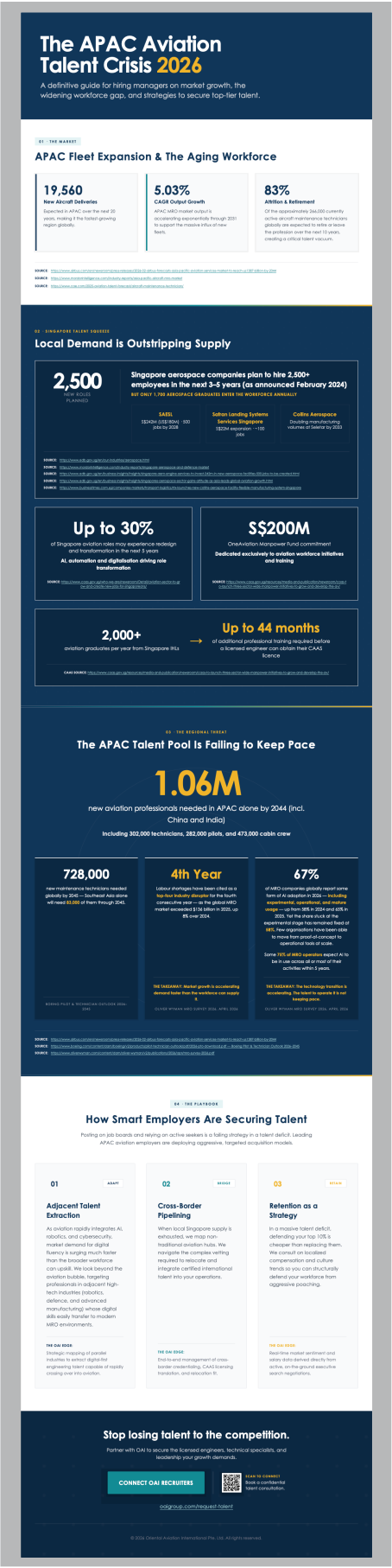
The sheer volume of aircraft entering the market is staggering. Airlines are placing record orders, yet supply chain constraints are severely delaying deliveries. At the beginning of 2026, the global aircraft order backlog was about 17,000 aircraft, with Oliver Wyman estimating it will take more than 12 years to clear at current production rates.
Because new aircraft are delayed, legacy fleets must remain operational far beyond their intended retirement dates, necessitating rigorous, intensive heavy maintenance. Furthermore, newer engine variants require earlier-than-expected shop visits.
IATA reports that groundings of Pratt & Whitney GTF‑powered aircraft peaked in March 2025 at 648 airframes, equal to 28% of the global GTF fleet. This ageing legacy frames and bottlenecked new engines have created a backlog that demands an unprecedented expansion in MRO capacity.
The MRO Talent Shortage Behind the Growth Numbers
While hangar space can be built and tooling procured, the human element remains the true operational bottleneck. The regional demand for skilled hands on the hangar floor is accelerating faster than training pipelines can supply them.
As of 2025, the global civil aviation sector is projected to require approximately 1.465 million new civil aviation professionals over a 10-year forecast period ending in 2034, including 416,000 aircraft maintenance technicians.
When the MRO talent shortage intersects with record fleet expansion, the result is deferred maintenance, prolonged turnaround times, and significantly squeezed margins for aviation service providers unable to adequately staff their production lines.
Singapore's MRO Talent Shortage: Why Local Supply Cannot Meet Local Demand
Quantifying the Singapore Supply-Demand Gap
OEM Expansions Are Compressing the Talent Pool Further
Adding to the intense pressure on Singapore’s MRO talent shortage is the expansion of international tier-one aerospace companies in the republic. As of February 2024, global aerospace companies Airbus, GE Aerospace, Pratt & Whitney, Rolls-Royce, Thales, and others have committed to invest over SGD 750 million across 10 projects in Singapore over a five-year period.
Furthermore, as of Q1 2026, independent third-party providers accounted for 39.8% share of the Asia-Pacific aircraft MRO market in 2025. This means that independent shops are now locked in a fierce, escalating bidding war for the exact same limited pool of licensed technicians that major OEMs are actively recruiting to staff their newly funded megaprojects.
The Aviation Digital Skills Gap in MRO: How Technology Is Compounding the Talent Shortage
Solving the manpower equation requires looking beyond domestic borders.
Every year, more than 2,000 students graduate from various Institutes of Higher Learning (IHLs) in Singapore. However, there are an additional 18 months of training for those who apply to become Air Traffic Control Officers (ATCOs) and 44 months for Licensed Aircraft Engineers (LAEs) before obtaining their professional licenses.
The regional dynamics of the APAC aviation sector mean talent supply is fluid, and Singapore must compete with neighbouring markets facing their own demographic and operational crises.
Regional Competition for MRO talent
Across Asia-Pacific, MRO employers are competing for a finite pool of licensed maintenance engineers and technicians, with several markets facing their own structural constraints. Japan’s MRO sector continues to grow but is already signalling concerns about long‑term talent availability due to an ageing technical workforce and rising recruitment costs, which directly pressure labour supply and pricing power for local providers.
In Australia, training providers and industry bodies describe a ‘critical’ aircraft maintenance engineer shortage and highlight the need to expand training pipelines to meet domestic demand, underscoring that Australia functions more as a competing demand market than a surplus source of exportable MRO talent.
Hong Kong’s aviation ecosystem, meanwhile, has repeatedly reported manpower shortages at its main hub and has had to introduce measures such as targeted job fairs, labour-import discussions, and operational technology adoption to stabilise staffing levels as traffic recovers.
The Next-Generation Digital Skills Gap in APAC MRO
Complicating this regional tug-of-war for headcount is the changing nature of the work itself. It’s worth noting that 30% of Singapore’s aviation roles will be redesigned in the next 5 years. The rapid integration of digital twins, predictive analytics, and automated inspection tools is creating a severe aviation digital skills gap in MRO. Apart from needing more mechanics, the MRO also needs technicians capable of interfacing with complex open-architecture avionics and cloud-based diagnostic networks.
Recognising this critical pivot, the government has intervened aggressively. The Civil Aviation Authority of Singapore established a SGD 200 million OneAviation Manpower Fund to support workforce transformation, recruitment, and upskilling initiatives.
This fund is vital for job redesign, shifting roles from purely manual labour to technology-augmented diagnostics, but executing this transition requires specialised strategic partners who understand how to deploy these frameworks effectively on the hangar floor.
Aviation Talent Retention Strategies for MRO Employers: What the Data Reveals
Why Singapore's MRO Talent Shortage Makes Reactive Hiring No Longer Viable
The financial reality of the talent war is stark. In 2025, aircraft turbine specialists in Singapore earned an average annual salary of SGD 85,000 (USD 66,045), representing a 12% annual increase that squeezed independent shops’ margins. Relying on reactive hiring in an inflationary wage environment quickly erodes profitability.
Furthermore, the push for sustainability adds new layers of operational complexity. The Civil Aviation Authority of Singapore (CAAS) will begin implementing the Sustainable Aviation Fuel (SAF) levy for flights departing from 1 January 2027, with the proceeds going towards the purchase of sustainable aviation fuel.
This mandate is directly driving demand for retrofit packages that combine fuel-system checks with cabin reconfigurations, underscoring the critical need to retain a highly skilled and adaptable technical workforce.
Regional Sourcing Intelligence — Where the Talent Pool Actually Exists
To build resilience, MROs must broaden their horizons. True talent solutions require validated regional sourcing intelligence. Emerging markets in Southeast Asia hold significant potential, but tapping into these pipelines requires more than just posting a job advertisement; it demands an intricate understanding of cross-border credentialing, visa processing, and cultural integration.
Policy developments are beginning to reinforce this regional shift. From 1 January 2025, the Johor–Singapore Special Economic Zone (JS-SEZ) introduced targeted tax incentives to attract high-value investments in sectors such as aerospace and advanced manufacturing. Qualifying companies investing at least RM500 million can access a preferential 5% corporate tax rate for up to 10–15 years, while larger investments exceeding RM1 billion receive the same rate for a longer duration. In parallel, favourable personal income tax rates for skilled professionals further enhance talent mobility.
These incentives, significantly lower than Malaysia’s standard 24% corporate tax rate, signal a deliberate push to align capital inflows with cross-border workforce movement, accelerating the integration of Singapore’s demand with Johor’s growing talent and cost advantages.
Retention as Workforce Intelligence — The Cost of Losing Experienced Staff
How OAI Supports Aviation Employers Navigating This Market
Navigating the complexities of the 2026 MRO landscape requires more than a traditional recruitment agency; it demands a workforce partner. OAI stands at the intersection of industry expertise and workforce intelligence, delivering comprehensive talent solutions tailored specifically for the aerospace sector.
With proprietary cross‑border sourcing networks, OAI possesses the agility to balance local supply deficits with validated regional talent. We guide aviation employers through the intricacies of job redesign and structured upskilling, helping them modernise maintenance roles, close emerging digital skills gaps, and implement retention strategies that protect their bottom line.
Secure your technical MRO pipeline. Submit your business enquiry at https://oaigroup.com/request-talent/.
Infographics done by: Jocelyn Lim